Description
Replacement Pads for Solo Motorsports 15″ Big Brake Kit
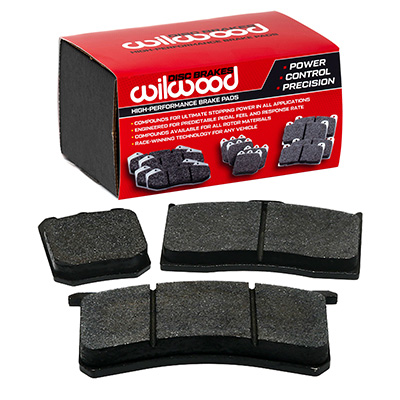
Replace worn front brake pads on your Solo Motorsports Ford 15″ Big Brake Kit with the correct Wilwood 6712-series replacement pad set.
These pads are designed for the Wilwood DynaPro 6-piston calipers used in our 15″ brake system and are available in two compounds so you can choose the braking characteristics that best match how you use your Bronco.
Each option includes a complete axle set of four brake pads.
BP-22 – Street / Performance
The Wilwood BP-22 is the best choice for Broncos that spend significant time on the street while still seeing spirited driving, towing, or occasional hard off-road use.
BP-22 uses a ceramic-based performance compound designed to provide smooth engagement, predictable pedal feel, and consistent braking while keeping dust, noise, and rotor wear lower than more aggressive race-oriented compounds.
BP-22 Characteristics
- Street-friendly performance compound
- Ceramic-based friction material
- Smooth, predictable engagement
- Lower brake dust and noise
- Reduced rotor wear
- Consistent friction through a broad temperature range
- Good choice for street-driven and dual-purpose Broncos
Wilwood Part Number: 150-22-6712K
BP-28 – High-Temperature / Off-Road
The Wilwood BP-28 is the more aggressive option for Broncos that see demanding off-road use, repeated hard braking, or higher operating temperatures.
BP-28 provides medium-high friction with strong initial bite, consistent pedal feel, and improved resistance to brake fade as temperatures increase.
BP-28 Characteristics
- Higher-friction performance compound
- Stronger initial bite
- Predictable pedal feel
- Excellent modulation and release
- Increased high-temperature fade resistance
- Well suited for off-road and demanding performance use
Wilwood Part Number: 150-28-6712K
Specifications
Pad Shape: Wilwood 6712
Pad Thickness: Approximately 0.49″
Caliper Application: Wilwood DynaPro 6
Quantity: 4 Pads / Complete Front Axle Set
Compound Selection
BP-22: Recommended for street-driven Broncos, daily use, towing, and mixed street/off-road driving.
BP-28: Recommended for more aggressive off-road use, repeated hard braking, and higher brake temperatures.
Fitment
Designed as replacement brake pads for the Solo Motorsports 1980–1996 Ford Dana 44 15″ Big Brake Kit using Wilwood DynaPro 6 calipers.
Important: These pads are intended for the Solo Motorsports 15″ big brake system. Verify your caliper and existing pad shape before ordering if your brake system has been modified.
STREET VEHICLES
After installing new pads, test the brake system at low speeds to determine if the vehicle is safe to operate. The following procedures should be conducted in a safe environment where speeds limits can be safely achieved up to 65 MPH. Side streets and traffic are minimal, and nobody is behind you when rapidly decelerating. It is the driver's responsibility to adhere to all traffic laws and exercise good judgment.
- Begin with a series of light decelerations to gradually build some heat in the brakes. Use an on-and-off pedal technique by applying the brakes for 3-5 seconds, and then allow them to fully release for a period roughly twice as long as the deceleration cycle. If you use a 5 count during the deceleration interval, use a 10 count during the release to allow the heat to sink into the pads and rotors.
- After several cycles of light stops to begin warming the brakes, proceed with a series of medium to firm deceleration stops to continue raising the temperature level in the brakes.
- Finish the bedding cycle with a series of 8-10 hard decelerations from 55-65 MPH down to 25 MPH while allowing a proportionate release and heat-sinking interval between each stop (20-30 seconds). The pads should now be providing positive and consistent response.
- If any amount of brake fade is observed during the bed-in cycle, immediately begin the cool down cycle.
- Drive at a moderate cruising speed, with the least amount of brake contact possible, until most of the heat has dissipated from the brakes. Avoid sitting stopped with the brake pedal depressed and do not apply the parking brake. Park the vehicle and allow the brakes to cool to ambient air temperature.
WARNING: Do not use high-temperature race pads for low to medium temperature driving on the street. In addition to undesirable driving qualities, it can also cause damage and cause premature wear to both the pads and rotors.
NOTE: NEVER allow the contact surfaces of the pads or rotors to be contaminated with brake fluid. Always use a catch bottle with a hose to prevent fluid spill during all brake bleeding procedures.
COMPETITION VEHICLES
After installing new pads, test the brake system at low speeds to determine if the vehicle is safe to operate. The following procedures should be conducted on a race track or other safe location where acceleration and rapid deceleration can be done safely. Make sure nobody is behind you before decelerating.
New pads must be deliberately brought up to temperature through a series of controlled cycles and then slowly cooled. If the pads are put into hard service right from the start, damage from fractures or accelerated deterioration can occur due to extreme temperature variations between the surface and the body of the pad.
- If your race car is equipped with brake cooling ducts, blocking them will allow the pads and rotors to warm up quicker and speed up the bedding process.
Temperature-indicating strips on the calipers can provide valuable data regarding observed temperatures during the bedding process and subsequent on-track sessions. This information can be highly beneficial when evaluating pad compounds and cooling efficiencies.- Proceed with a series of 8-10 hard decelerations from 55-65 MPH down to 25 MPH while allowing a proportionate release and heat-sinking interval between each stop (20-30 seconds). The pads should now be providing positive and consistent response.
- If any amount of brake fade is observed during the bed-in cycle, immediately begin the cool down cycle.
- Cool Down: drive at a moderate cruising speed, with the least amount of brake contact possible, until most of the heat has dissipated from the brakes. Avoid sitting stopped with the brake pedal depressed and do not apply the parking brake. Every few minutes roll the car forward or backward enough to exchange the rotor area from behind the hot pads. Allow the brakes to cool to ambient air temperature.
POST-BEDDING INSPECTION After the bedding cycle, the rotors should exhibit a uniformly burnished finish across the entire contact face. Any surface irregularities that appear as smearing or splotching on the rotor faces can be an indication that the brakes were brought up to temperature too quickly during the bedding cycle. If the smear doesn’t blend away after the next run-in cycle, or if chatter under braking results, sanding or resurfacing the rotors will be required to restore a uniform surface for pad contact.
PRE-RACE WARM UP Always make every effort to get heat into the brakes prior to each event. Use an on-and-off the pedal practice to warm the brakes during the trip to the staging zone, during parade laps before the flag drops, and every other opportunity in an effort to build heat in the pads and rotors. This will help to ensure best consistency, performance, and durability from your brakes.
NOTE: NEVER allow the contact surfaces of the pads or rotors to be contaminated with brake fluid. Always use a catch bottle with a hose to prevent fluid spill during all brake bleeding procedures.
This product fits the following vehicles:
| Make |
Model |
Year |
Engine |
| Make |
Model |
Year |
Engine |
| Ford |
Bronco |
1980-1986 |
|
| Ford |
Bronco |
1987-1991 |
|
| Ford |
Bronco |
1992-1996 |
|
| Ford |
F-150 |
1980-1986 |
|
| Ford |
F-150 |
1987-1991 |
|
| Ford |
F-150 |
1992-1996 |
|